Introduction
I honestly thought I already wrote a blog post that discussed this but realized it was a podcast episode. So, here I am writing regarding if we should trust the Christian bible as we know it. We will be going over both external and internal sources regarding Manuscript Evidence, Influence on Literature and Culture, Archaeological Evidence, Historical Accuracy, and translation variables. So buckle up! This is going to be quite the post and plenty to read to ultimately bring truth and clarity.
Sub-Introduction
People from around the world know of the bible and know of Christianity. It is one of the most hated, loved, researched, criticized, collection of historical documents in history. Wars have been fought over it, live have been lost, taken, destroyed, redeemed, healed, put at peace, and many other things I could say regarding this. To start, the bible is not just one book, it was written over 2,000 years, 3 continents, in 3 different languages. Not only that, but The New Testament has been preserved in more manuscripts than any other ancient work of literature, with over 5,800 Greek manuscripts cataloged. There are also 10,000 Latin manuscripts and 9,300 in other ancient languages. So, with that said, lets dig in.
Manuscript Evidence
As i mentioned in the paragraph above, with that amount of documentation, per the Biblical scholars Norman Geisler and William Nix, the New Testament has a 99.5% purity rate in terms of accuracy (source). Most disagreements are non fundamental to the Christian faith such as one writing will say Jesus Christ and another will say Christ Jesus. Lets talk about non biblical documents and what we call authentic in this regard.
The Annals (Written by Tacitus)
The Annals was Tacitus‘ (Roman historian and senator) final work and provides a key source for modern understanding of the history of the Roman Empire from the beginning of the reign of Tiberius in AD 14 to the end of the reign of Nero, in AD 68.
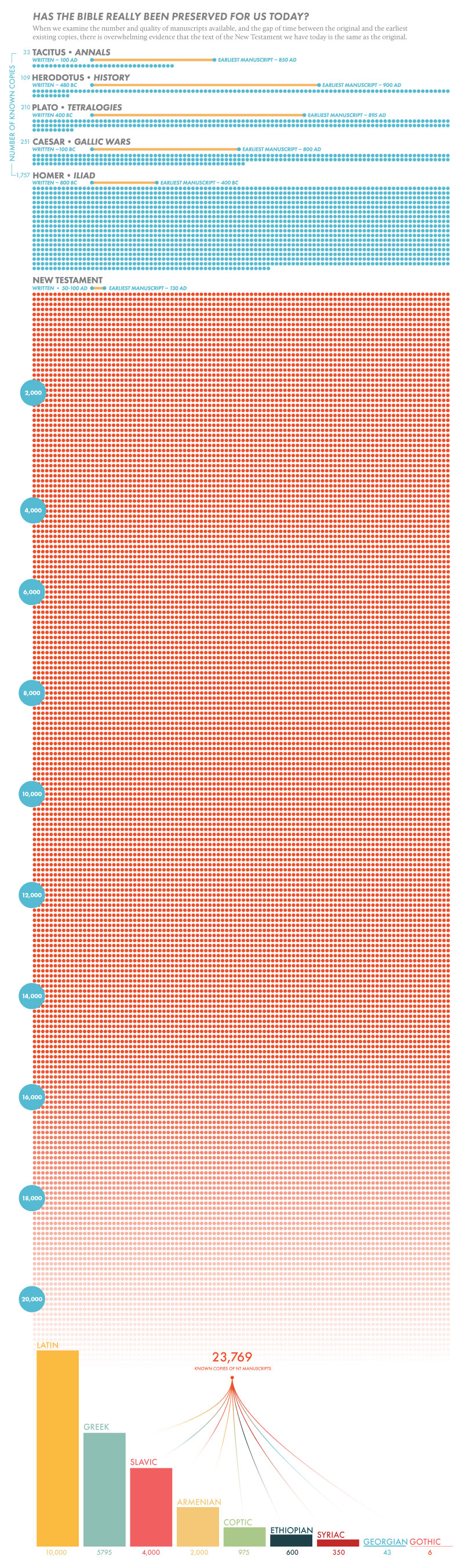
From historians and archeologists findings, We understand these were written around 100 AD but the earliest copy we have is from 840 AD with around 33 different copies. This is considered some of the best documents we have regarding the subject of these documents.
Herodotus (Historian)
Herodotus was a Greek historian (484 – 425 BC) and geographer from the Greek city of Halicarnassus, part of the Persian Empire (now Bodrum, Turkey) and a later citizen of Thurii in modern Calabria, Italy. He is known for having written the Histories – a detailed account of the Greco-Persian Wars. Herodotus was the first writer to perform systematic investigation of historical events. He has been described as “The Father of History“, a title conferred on him by the ancient Roman orator Cicero.
We understand that most of his works are written during the mid 400 BC era yet the earliest written copies we have of his work are from 900 AD with 109 copies (source). This is considered history and very strong case for his life and what he wrote.
Homar (Iliad)
The Iliad is a poem about Ilion (Troy) and is one of two major ancient Greek epic poems attributed to Homer. It is one of the oldest extant works of literature still widely read by modern audiences. As with the Odyssey, the poem is divided into 24 books and was written in dactylic hexameter. It contains 15,693 lines in its most widely accepted version.
We know it was written around 800 BC during Homers life yet the earliest copies we have are from 400 BC with over 1,757 copies after that date that we have in history today (source).
New Testament
Lets reiterate what we just learned, All of the above are historically accepted as truth and authentic. The New Testament alone, was written 50-100 AD with the earliest manuscripts being written as early as 130 AD with over 25,000 copies, over 3 continents, over 9 different languages, with a 99.5% accuracy within each other (source). So with this we can say that the accounts of Jesus and early disciples were accurate from a historical stand point.
Manuscript Evidence Conclusion
In light of the evidence, it becomes clear that the New Testament stands on remarkably solid ground when it comes to historical authenticity. Compared to other ancient texts that are widely accepted as reliable sources of historical information, such as Tacitus’ Annals, the works of Herodotus, and Homer’s Iliad, the New Testament not only holds its own but far surpasses them in terms of manuscript evidence and accuracy. With over 25,000 copies spread across three continents and nine languages, and a 99.5% purity rate, the New Testament’s historical reliability is unparalleled. This wealth of documentation affirms that the accounts of Jesus and the early disciples are not just faith-based claims, but are also supported by rigorous historical scrutiny. As such, the New Testament should be regarded as an authentic and trustworthy record, not only within the context of Christian faith but also in the broader scope of historical scholarship.
Non Christian Historians
One argument i’ve had people use at me is “a seemingly historical contextual document referencing itself as truth is a fallacy for a fundamental ideology to follow. ” (yes, that…). So simply said, the bible says its true so it is true is not enough. Lets discuss the New Testament once again, (the old testament is used commonly to locate archeological sites and cities and isn’t the main controversy of the bible people hate) Jesus being the core of the new testament and his death and resurrection.
Tacitus
Remember this from above? Yes, The Roman historian and senator Tacitus referred to Jesus, his execution by Pontius Pilate, and the existence of early Christians in Rome in his final work, Annals (written c. AD 116), book 15, chapter 44.
The context of the passage is the six-day Great Fire of Rome that burned much of the city in AD 64 during the reign of Roman Emperor Nero. The passage is one of the earliest non-Christian references to the origins of Christianity, the execution of Christ described in the canonical gospels, and the presence and persecution of Christians in 1st-century Rome.
There are two points of vocabulary in the passage. First, Tacitus may have used the word “Chrestians” (Chrestianos) for Christians, but then speaks of “Christ” (Christus) as the origin of that name. Second, he calls Pilate a “procurator”, even though other sources indicate that he had the title “prefect”. Scholars have proposed various hypotheses to explain these peculiarities.
The scholarly consensus is that Tacitus’s reference to the execution of Jesus by Pontius Pilate is both authentic, and of historical value as an independent Roman source.
Josephus
The first-century Jewish historian Flavius Josephus provides external information on some people and events found in the New Testament. The extant manuscripts of Josephus’ book Antiquities of the Jews, written around AD 93–94, contain two references to Jesus of Nazareth and one reference to John the Baptist.
The first and most extensive reference to Jesus in the Antiquities, found in Book 18, states that Jesus was the Messiah and a wise teacher who was crucified by Pontius Pilate. Modern scholarship has largely acknowledged the authenticity of the second reference to Jesus in the Antiquities, found in Book 20, Chapter 9, which mentions “the brother of Jesus, who was called Christ, whose name was James.”
Pliny the Younger
Pliny the Younger, the Roman governor of Bithynia and Pontus (now in modern Turkey), wrote a letter to Emperor Trajan around AD 110 and asked for counsel on dealing with the early Christian community. The letter (Epistulae X.96) details an account of how Pliny conducted trials of suspected Christians who appeared before him as a result of anonymous accusations and asks for the Emperor’s guidance on how they should be treated. The letter is the first pagan account to refer to Christianity, providing key information on early Christian beliefs and practices and how these were viewed and dealt with by the Romans. The letter and Trajan’s reply indicate that at the time of its writing there was no systematic and official persecution of Christians in the Roman Empire.
Suetonius
Christians are explicitly mentioned in Suetonius’ (Roman historian 69 AD – 122 AD) biography of the Emperor Nero (Nero 16) as among those punished during Nero’s reign. These punishments are generally dated to around AD 64, the year of the Great Fire of Rome. In this passage Suetonius describes Christianity as excessive religiosity (superstitio) as do his contemporaries, Tacitus and Pliny which I have referenced previously.
Overall, Some scholars estimate that there are about 30 surviving independent sources written by 25 authors who attest to Jesus (source).
Non Christian Historians Conclusion
In conclusion, the historical validity of Jesus’ existence and the events surrounding His life, death, and resurrection are not solely reliant on the New Testament’s self-referential claims. Instead, they are corroborated by numerous independent sources from the ancient world. Esteemed historians such as Tacitus, Josephus, Pliny the Younger, and Suetonius—all non-Christian—provide critical external attestations to the existence of Jesus and the early Christian movement. These accounts, written by those with no vested interest in promoting Christianity, serve as powerful evidence that the events described in the New Testament are rooted in historical reality. While some may argue that the Bible’s claims are circular, the broader context of historical documentation demonstrates that the story of Jesus is not merely a theological assertion but a well-attested historical fact. Thus, when considering the authenticity of the New Testament, one must acknowledge the weight of this external evidence, which aligns with and supports the biblical narrative.
Translations Translations Translations
I’ll start this section by saying English is a very broken language. I mean this because we may use the word “love” for example and say, “I love this burger!” and then go to your S.O. and say, “I love you” but I would hope that your feelings for the burger are not the same as the ones for your S.O.. There are many words of this matter when translated from any language to English that make it difficult to get the point across. This is accurate for translations of the bible from Greek, Hebrew, and Aramaic.
So why so many translations? How can we trust anything we read in English? Do we have to learn Greek or Hebrew?
The various translations I would separate into three categories, Word-for-word, Thought-for-thought, and Paraphrase but think of it as linear.
Just to visualize, on the left side of this line you have the Word-for-word category, in the middle you have Thought-for-thought, then finally on the right you have Paraphrase. All translations are on this line somewhere.
Word-for-Word
This is a great category for those who want to study and really get into what the original text had to offer. Usually Verses that are translated into English as word-for-word will be longer, more wordy, and a lot more descriptive as Hebrew and Greek words had long English translations. Some of the best translations in this category are, Interlinear (the original text), NASB, AMP, ESV, RSV, KJV, and NKJV. Pairing these with study tools like a concordance will be the most in depth way to study scripture.
Thought-for-Thought
This category finds the best English words to best match that of the original text. These can change often since English language is always evolving. This gives way to a lot more translations within this category since new versions come out as English evolves. Some of the best translations in this category are, HCSB, NRSV, NAB, NJB, NIV, TNIV, and NCV. This is good for groups of people reading together and more commonly used in Churches since it is easy to read and easier to share with people who may not want the complexities of Greek or Hebrew.
Paraphrase
This category of translations is best for people who are new and trying to learn or get a different perspective (without changing the core of the message) so they can better wrap their mind around the bible. A common practice is to have a Word-for-word bible and reread the passage in a Paraphrase translation to help grasp the idea if the passage. The growing concern with this category is newer churches or organizations are creating these based off of other paraphrased translations to create new ones. The core concept of Paraphrase category is to base it off of the original texts. For example, The Passion Translation is on a very thin line of being accurate and heresy due to the changed concepts of multiple verses that many scholars and theologians would easily discredit with scripture. So with that said, some of the best translations in this category are, NLT, NIrV, GNT, CEV, TLB, and the MSG.
Translations Conclusion
In conclusion, understanding the different categories of Bible translations can greatly enhance our study and comprehension of Scripture. While English, with its limitations and evolving nature, may pose challenges in conveying the full depth of the original languages, the various translations available today offer a range of approaches to bridge this gap. Whether you’re diving deep into the original meaning with word-for-word translations, seeking clarity and readability with thought-for-thought versions, or exploring new perspectives with paraphrased texts, each translation serves a unique purpose in helping us connect with the Bible’s message. However, it’s crucial to approach these translations with discernment, recognizing their strengths and limitations. By using a combination of translation types, we can gain a richer and more nuanced understanding of God’s Word, ensuring that the core message remains intact and accessible to all who seek it.
Other Sources
Please check out these other writers, historians, articles and more regarding the authenticity of the bible:
1. How do we know the Bible is authentic and true
2. The Manuscripts
3. The Message
4. Authenticity of Scripture
5. The Authenticity of the Bible
6. Compelling Evidence of the Authenticity of the Bible
7. 40 Different Authors, 3 Continents, 3 Different Languages.
8. Has the Bible Been Preserved For Us Today?
9. Historicity of the Bible
10. Faith — Is the Bible Reliable and Accurate in Transmission?
11. Sources for the historicity of Jesus
12. Gospel Evidence that Jesus Existed
Conclusion
As we’ve explored throughout this blog post, the Christian Bible stands as an unparalleled document of historical, cultural, and spiritual significance. The overwhelming manuscript evidence, far exceeding that of any other ancient text, affirms the New Testament’s reliability as an authentic historical record. External sources, including writings from respected non-Christian historians like Tacitus, Josephus, and Pliny the Younger, corroborate the key events described in the New Testament, lending further credibility to its claims.
Moreover, the Bible’s preservation, despite centuries of intense scrutiny, opposition, and even attempts at eradication, is nothing short of miraculous. Its influence on literature, culture, and individual lives is unmatched, underscoring its profound impact across time and geography. The various translations available today, while reflecting the challenges of linguistic differences, offer rich opportunities for deeper understanding and connection with the Scriptures.
In conclusion, the Bible is not merely a religious text but a reliable, well-attested historical document that has stood the test of time. Its authenticity is supported by a wealth of evidence from both within and outside the Christian tradition. As we engage with the Bible, whether through scholarly study or personal devotion, we can be confident that we are encountering a text that is as trustworthy as it is transformative, a true testament to the enduring Word of God.
Blessings to you brothers and sisters and be strengthened in the faith for God is with you. Stay true, and be at peace.

 Gospel Truth Project