Introduction
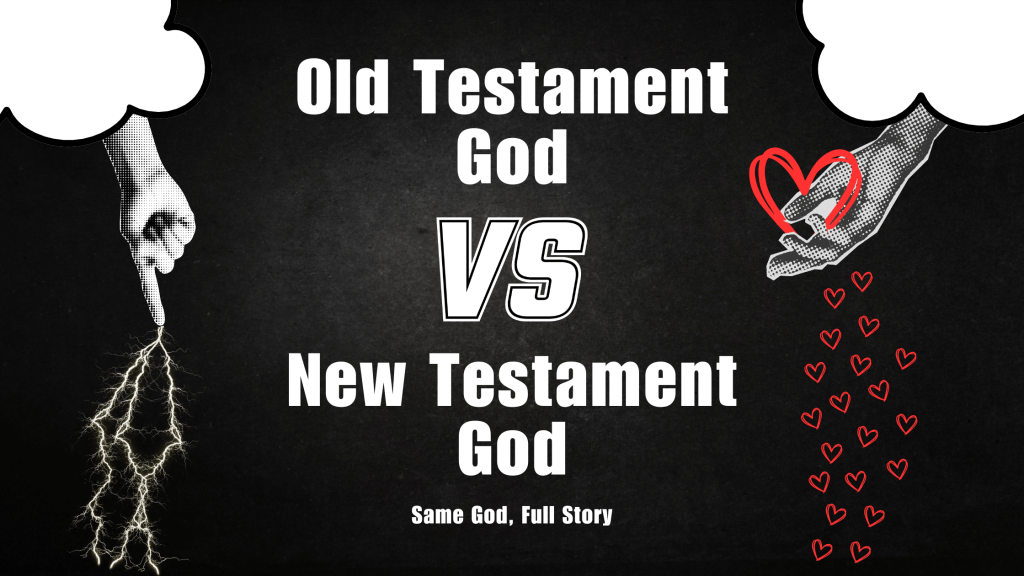
One of the most common and emotionally charged questions asked about Christianity is this: If God is good, why does the Old Testament contain so much death, destruction, and divine judgment?
For some, this question is raised by skeptics who see the God of the Old Testament as harsh, angry, merciless, or even cruel, while the God revealed in the New Testament appears loving, gracious, patient, and compassionate. For others, including sincere Christians, this question emerges quietly in moments of doubt when reading difficult passages that seem difficult to reconcile with a “good” God.
At first glance, it can feel as though we are being presented with two very different portrayals of God. One appears severe and judicial. The other appears gentle and merciful. This has led some to ask whether God changed, whether humanity’s understanding of Him evolved, or even whether the God of the Old Testament is a different being altogether.
Scripture itself, however, does not allow for that conclusion.
The Bible consistently affirms that God does not change. He is not divided, conflicted, or evolving morally over time. His character is the same yesterday, today, and forever. If that is true, then the tension many people feel is not evidence of two different gods, but evidence that we may be reading the Bible in fragments rather than as a unified whole.
This question is not new. The early Church confronted it directly and rejected the idea that Jesus revealed a different God than the one worshiped by Israel. The apostles, the early bishops, and the earliest Christian writings all affirmed that the God who spoke through Moses and the prophets is the same God revealed fully in Christ. Any attempt to divide them was understood as a misunderstanding of Scripture, not a deeper insight into it.
That means the real issue is not whether God changed, but whether we are properly understanding how Scripture works, how covenants function, and how grace, mercy, judgment, and consequence are woven together throughout the entire biblical narrative.
It is easy to isolate moments of death or judgment in the Old Testament and, when removed from context, conclude that God is volatile or merciless. But Scripture is not written as a collection of disconnected moral anecdotes. It is a continuous story of creation, rebellion, patience, warning, judgment, mercy, and ultimately redemption. When read as a whole, the Bible presents a God who is consistently holy, consistently just, and consistently merciful, even when His actions are uncomfortable to modern sensibilities.
This post is not written to dismiss hard questions or minimize the weight of difficult passages. It is written to slow down, examine the text carefully, and approach Scripture with humility, reason, and honesty. We will explore the difference between descriptive and prescriptive passages, the role of covenantal context, and why judgment and mercy are not opposites in the biblical worldview, but inseparable expressions of God’s character.
Whether you are a Christian wrestling with doubt or someone outside the faith genuinely seeking to understand the Christian response to this question, you are welcome here. Truth does not fear scrutiny. If Christianity is true, it should withstand careful examination, not require blind acceptance.
So rather than asking whether the God of the Old Testament is different from the God of the New Testament, we will ask a better question: What happens when we read the Bible the way it was meant to be read, as one unified story revealing one unchanging God?
Addressed to Those with Doubts
Before addressing claims, arguments, or accusations about God’s character, we need to pause and speak directly to those who are struggling with doubt.
Doubt, in itself, is not sinful. Scripture never condemns the act of questioning. What Scripture consistently warns against is what we do with doubt. Doubt can become either a doorway to deeper truth or a seed of quiet destruction, depending on whether it leads us toward humility and study or toward cynicism and disengagement.
Many believers carry unspoken doubts because they fear asking hard questions will label them as weak, unfaithful, or dangerous. Others are told, directly or indirectly, that faith requires silence rather than understanding. That idea does not come from Scripture.
The Bible repeatedly invites examination, testing, and discernment. We are told to “test everything; hold fast what is good” (1 Thessalonians 5:21). We are instructed to rightly handle the word of truth (2 Timothy 2:15), which assumes effort, learning, and careful thought. Even Jesus Himself responded to doubt not with shame, but with evidence. When Thomas struggled to believe the resurrection, Christ did not rebuke him for asking. He invited him to examine the wounds (John 20:27).
One of the most honest prayers in Scripture comes from a desperate father who cries out, “I believe; help my unbelief!” (Mark 9:24). That prayer is not rejected. It is met with compassion and power. Scripture shows us that faith is not the absence of questions, but the willingness to bring those questions to God rather than away from Him.
For those who are not Christians and are genuinely curious about this topic, your presence here matters as well. This conversation is often avoided because it forces believers to slow down, confront difficult texts, and resist shallow answers. That discomfort does not mean the faith is fragile. It often means it has not been carefully examined.
Christianity does not ask for blind faith. It asks for informed trust. Biblical faith is never portrayed as belief without reason, but belief grounded in revelation, testimony, history, and coherence. The apostle Peter instructs believers to be ready to give a reasoned defense for their hope, doing so with gentleness and respect (1 Peter 3:15). A faith that cannot be examined is not the faith the apostles taught.
The early Church understood this well. The first generations of Christians did not grow in a protected intellectual bubble. They lived in a world filled with competing philosophies, pagan religions, and accusations that their beliefs were immoral or irrational. Rather than retreat, they wrote, debated, and reasoned from Scripture. They did not fear scrutiny because they believed truth could withstand it.
That is the posture this discussion requires.
If the God revealed in Scripture is truly good, just, and unchanging, then His actions must be understood within their proper context rather than judged through modern assumptions or selective reading. Doubt often arises not because God has failed to reveal Himself clearly, but because we have inherited incomplete explanations or have been taught to read the Bible in fragments instead of as a unified narrative.
This section is not meant to resolve every emotional response to difficult passages. It is meant to establish a foundation: questioning is not rebellion, but avoiding the search for truth is. The goal here is not to win an argument, but to pursue understanding honestly and faithfully.
With that foundation laid, we can now address the central claim directly.
The Claims
The claim itself is often presented as simple, even obvious, but it is far more layered than it first appears.
The argument goes something like this:
The God of the Old Testament is portrayed as angry, violent, merciless, controlling, and judgment-driven. He brings floods, plagues, wars, and death. He destroys cities, commands judgment against nations, and enforces laws with severe consequences. Then, suddenly, in the New Testament, God appears loving, patient, gracious, compassionate, and eager to save. Jesus heals instead of destroys. He forgives instead of condemns. He eats with sinners instead of striking them down. How can these two portrayals possibly refer to the same God?
From this perspective, several conclusions are often suggested.
Some argue that God changed. Perhaps humanity evolved morally, and God adjusted His approach. Others suggest that Israel misunderstood God and projected their own brutality onto Him. Some go further and claim that the God of the Old Testament was not truly revealed by Jesus at all, but replaced by a more loving deity in the New Testament. Even when these ideas are not stated explicitly, they often shape how people read Scripture.
At the core of each explanation is the same assumption: that love and judgment are opposites, and that a good God cannot meaningfully exercise both.
This assumption is rarely examined. Instead, modern definitions of “good” are quietly imported into the text and used as the measuring stick by which God Himself is judged. In contemporary culture, goodness is often defined as non-confrontational, permissive, emotionally affirming, and unwilling to impose consequences. A god who judges is seen as dangerous. A god who punishes is seen as immoral. A god who sets boundaries is seen as oppressive.
But Scripture does not operate under that definition. It is also worth stating plainly that the New Testament is not a judgment-free correction of the Old Testament. Jesus speaks more about judgment and hell than any Old Testament prophet (Matthew 10:28; Matthew 23). The New Testament warns of divine accountability, eternal consequences, and final judgment with clarity and seriousness (Acts 5:1–11; Romans 2:5–8; Revelation 20:11–15).
The difference is not that judgment disappears in the New Testament, but that its ultimate resolution is revealed in Christ.
The Bible consistently presents God as holy, just, and merciful at the same time. These are not competing traits. They are inseparable aspects of His character. In the Old Testament, God repeatedly describes Himself as compassionate and slow to anger, abounding in faithful love, yet unwilling to ignore evil. In the New Testament, that same God speaks of judgment, accountability, and eternal consequences, often in stronger language than what appears in the Hebrew Scriptures.
If the Old Testament God is judged solely by moments of judgment, and the New Testament God is judged solely by moments of mercy, the conclusion will always be distorted. Both Testaments contain grace and judgment. Both contain patience and consequence. Both reveal a God who desires repentance and a God who will not allow evil to continue indefinitely.
The claim also overlooks something critical: the New Testament does not soften God’s view of sin. It intensifies it. Jesus does not lower the moral standard; He raises it. Anger becomes heart-level murder. Lust becomes heart-level adultery. Hypocrisy is publicly condemned. Judgment is not removed from the conversation; it is clarified and eternalized.
So if God did not change, and Scripture insists He did not, then something else must explain the difference in tone many readers perceive.
Either the Bible contradicts itself, or we are misunderstanding how God reveals Himself across time, covenant, and context.
This is where many discussions stall. Some resolve the tension by rejecting the Old Testament. Others resolve it by watering down judgment. Others simply avoid the issue altogether. But none of those approaches are faithful to Scripture, nor are they intellectually satisfying.
Before we can answer whether God is different between the Old and New Testaments, we must first understand how God describes Himself, how Scripture unfolds as a unified story, and how covenantal context shapes the way His justice and mercy are expressed.
That work begins by looking carefully at how God is actually described in both Testaments, rather than how He is assumed to be.
Descriptions of God
If the God of the Old Testament and the God of the New Testament are truly different, then that difference should be visible in how God describes Himself. Scripture does not leave us guessing about God’s identity, character, or nature. Across both Testaments, God reveals Himself through names, titles, and attributes that consistently point to the same divine being acting within different covenantal contexts.
God as Revealed in the Old Testament
In the Old Testament, God is most commonly identified as Elohim, a title emphasizing His power as Creator and sovereign ruler over all things. From the opening line of Genesis, God is presented not as a tribal deity, but as the universal source of life and order.
Alongside Elohim, God reveals His personal covenant name to Moses as YHWH (often rendered as LORD in English translations), a name tied to His eternal, self-existent nature (Exodus 3:14-15). This is not the name of a distant force, but of a relational God who binds Himself to a people, makes promises, and remains faithful to them.
Throughout the Hebrew Scriptures, God is also described using relational and functional titles that reflect both authority and care:
- Adonai (Lord, Master)
- El Shaddai (God Almighty)
- El Elyon (Most High God)
God also reveals His character through compound covenant expressions such as “The LORD will provide” and “The LORD is peace,” emphasizing that His power is exercised not arbitrarily, but purposefully and relationally.
Most importantly, God explicitly defines His own character in Exodus 34:6-7. He declares Himself compassionate and gracious, slow to anger, abounding in faithful love, forgiving iniquity, yet unwilling to ignore guilt. Mercy and justice appear together, not in tension, but in harmony. This self-description becomes a repeated refrain throughout the Old Testament and forms the theological backbone for understanding divine judgment.
The Old Testament does not present a God who delights in destruction. It presents a God who is patient, faithful, morally consistent, and deeply concerned with both righteousness and restoration.
God as Revealed in the New Testament
In the New Testament, God is most commonly referred to as Theos (God) and Kyrios (Lord), titles that carry forward the authority and sovereignty expressed in the Old Testament. When early Christians confessed Jesus as Lord, they were intentionally using language associated with YHWH, not introducing a separate deity.
One of the most distinctive features of the New Testament is the way Jesus speaks of God as Father (Pater), inviting believers into a relational intimacy that had always existed but was now being fully revealed. Jesus also uses the Aramaic term Abba, which expresses closeness and trust within a family relationship. This language communicates intimacy without diminishing God’s holiness or authority.
The New Testament continues to apply titles to God that emphasize continuity rather than change. God is described as Almighty, Creator, Savior, and Judge. He is identified as the Beginning and the End, the Alpha and the Omega. These titles mirror Old Testament descriptions and affirm the same eternal nature.
Jesus Himself bears names that explicitly connect Him to the God of Israel. His name means “The LORD saves.” He is called the Anointed One, the promised Messiah, and Immanuel, “God with us.” These titles do not replace the God of the Old Testament; they fulfill the promises made by Him.
Continuity, Not Contradiction
When the names and titles of God are examined carefully, the claim of two different gods collapses. The God revealed in the New Testament is not a softer replacement for the God of the Old Testament. He is the same holy, just, merciful God revealing Himself more fully through the person and work of Christ.
The early Church understood this clearly. Christian leaders in the second century explicitly rejected the idea that Jesus revealed a different God than the one worshiped in the Hebrew Scriptures. Irenaeus argued that the God proclaimed by Christ and the apostles is the same God who spoke through the prophets, and that separating the two undermines the entire biblical narrative.
The difference many readers perceive is not a change in God’s character, but a change in how His covenant relationship with humanity is administered. The Old Testament reveals God’s holiness, patience, and justice within a national covenant framework. The New Testament reveals that same holiness and justice fulfilled and mediated through Christ within a new covenant that extends to all nations.
Names matter. Descriptions matter. And when Scripture is allowed to speak for itself, the portrait that emerges is not of two competing gods, but of one unchanging God revealing Himself progressively within history.
The Bible Is One Consecutive Book
One of the most common mistakes made when reading Scripture is treating the Old Testament and the New Testament as two separate books telling two different stories about two different gods. While the Bible is divided into sections for readability and organization, it was never meant to be understood as fragmented or contradictory.
The Bible tells one continuous story.
From Genesis to Revelation, Scripture unfolds a unified narrative of creation, rebellion, covenant, promise, fulfillment, redemption, and restoration. The Old Testament is not a failed experiment that needed correction. It is the foundation that makes the New Testament intelligible. Without it, the gospel loses its depth, its meaning, and its context.
The Old Testament records God’s work through a particular people, Israel, chosen not because of their greatness, but to serve as a vessel through which God would reveal His character to the world and ultimately bring forth the Messiah. Through law, prophecy, poetry, and historical narrative, the Old Testament points forward, again and again, to a coming fulfillment. Sacrificial systems, covenants, kingship, and prophecy all function as signposts directing attention toward something greater that had not yet arrived.
The New Testament does not replace this story. It completes it.
When Jesus appears, He does not introduce a new theology detached from Israel’s Scriptures. He explicitly roots His mission in them. After His resurrection, Jesus explains to His disciples “beginning with Moses and all the Prophets” how the Scriptures spoke about Him. He affirms that the Law, the Prophets, and the Psalms were always moving toward this moment of fulfillment.
The author of Hebrews reinforces this continuity by explaining that God spoke through the prophets in earlier times and has now spoken through His Son. This is not a contradiction or a correction, but a progression in revelation. The same God is speaking, but the message is reaching its intended culmination.
This is where covenantal context matters.
The Old Testament primarily operates under the Mosaic covenant, while still anticipating a greater covenant promised by the prophets, which governed Israel as a nation with specific civil, ceremonial, and moral dimensions. The New Testament reveals the inauguration of the new covenant promised by the prophets, one that does not abolish God’s moral will but fulfills it through Christ and extends God’s redemptive work to all nations. The change is not in God’s character, but in how His relationship with humanity is administered.
Reading Scripture as one consecutive story also prevents selective interpretation. Judgment passages make sense when read alongside patience and warning. Grace passages make sense when read against the backdrop of holiness and justice. The cross itself cannot be understood apart from the law it fulfills or the sacrificial imagery that precedes it.
The early Church consistently affirmed this unity. Christian leaders argued that separating the Testaments destroys the gospel itself, because the promises, prophecies, and patterns of the Old Testament are inseparable from the person and work of Christ. The Church did not see the Old Testament as obsolete, but as essential Scripture that revealed the same God acting faithfully across history.
When the Bible is read as a single, unfolding narrative rather than a collection of disconnected moral snapshots, the perceived tension between the Old and New Testaments begins to dissolve. What remains is a coherent story of a holy God patiently working through human rebellion to accomplish redemption, culminating in Christ and continuing through His Church.
This unified story sets the stage for understanding why judgment and mercy appear differently across Scripture, not because God changes, but because the story itself is moving toward its intended goal.
Old Testament Examples of Mercy
One of the most persistent misconceptions about the Old Testament is that it presents a God eager to judge and slow to show mercy. When the text is actually read carefully, the opposite pattern emerges. Judgment is almost always preceded by patience, warning, and opportunities for repentance. Mercy is not an interruption of God’s justice. It is woven into it.
From the earliest pages of Scripture, God’s restraint is visible.
Sodom and Gomorrah: Mercy Before Judgment
The account of Sodom and Gomorrah is often cited as evidence of divine cruelty, yet the narrative itself emphasizes God’s patience and willingness to spare. Before judgment falls, God engages in a conversation with Abraham, allowing him to intercede on behalf of the city. God agrees repeatedly to withhold destruction if even a small number of righteous people can be found (Genesis 18:23–32).
This exchange reveals something critical about God’s character. Judgment is not impulsive. It is deliberate, relational, and restrained. The city is not destroyed because God refuses mercy, but because persistent wickedness remains unrepented despite opportunity (Genesis 18:20–21).
Even then, mercy is shown. Lot and his family are warned and led out before destruction comes (Genesis 19:12–17). The narrative presents God as a judge who exhausts mercy before executing justice, not one who delights in destruction.
Nineveh: Mercy Extended to Israel’s Enemies
Perhaps the clearest example of Old Testament mercy toward non-Israelites is the story of Jonah. God sends Jonah to Nineveh, a violent and oppressive city, not to announce immediate destruction, but to call them to repentance (Jonah 1:1–2; Jonah 3:1–4).
Jonah resists precisely because he knows God’s character. He openly admits that he fled because he knew God was gracious, compassionate, slow to anger, and abounding in faithful love (Jonah 4:2). When the people of Nineveh repent, God spares them and withholds judgment (Jonah 3:5–10).
This account directly contradicts the idea that Old Testament judgment is automatic or merciless. Mercy is extended even to Israel’s enemies when repentance occurs.
Delayed Judgment and Generational Patience
Another often-overlooked feature of Old Testament judgment is how frequently it is delayed. In Genesis, God tells Abraham that his descendants will not inherit the land immediately because “the iniquity of the Amorites is not yet complete” (Genesis 15:16). This statement implies restraint, patience, and moral accountability over time. Judgment is not based on ethnicity or conquest, but on accumulated, unrepentant evil.
Throughout Israel’s history, God sends prophets repeatedly to warn, correct, and call people back before judgment ever arrives (2 Chronicles 36:15–16). The books of the prophets are not records of sudden destruction, but of prolonged patience. God pleads, warns, delays, and grieves over rebellion (Isaiah 65:2; Jeremiah 7:25–26).
Judgment comes only after sustained rejection.
God’s Own Testimony About His Heart
Perhaps the strongest evidence for Old Testament mercy comes from God’s own words. Through the prophet Ezekiel, God declares that He takes no pleasure in the death of the wicked, but desires that they turn and live (Ezekiel 18:23; Ezekiel 33:11).
This is not a New Testament innovation. It is an Old Testament declaration of God’s heart.
Time and again, Scripture shows that when repentance occurs, judgment is halted or delayed. When humility is shown, mercy follows (1 Kings 21:27–29; 2 Chronicles 7:14). Even deeply flawed figures receive reprieve when they turn back toward God.
Addressing the Hardest Questions
Some readers struggle most with passages involving warfare and judgment against nations. These texts should not be approached casually or defensively. They require careful reading, historical awareness, and theological humility.
What can be said with certainty is this: the Old Testament never portrays God as judging arbitrarily or without warning. Judgment is consistently presented as judicial, purposeful, and tied to moral accountability (Deuteronomy 9:4–5). It is also presented within a covenantal context in which God is working to preserve a people through whom redemption will come (Genesis 12:1–3).
Scripture does not ask readers to celebrate judgment. It asks them to understand it. Mercy is present even in these difficult texts, though it is often expressed through restraint, delay, warning, and opportunity rather than immediate rescue.
A Pattern, Not an Exception
When Old Testament narratives are examined collectively rather than selectively, a clear pattern emerges. God warns before judging (Amos 3:7). God relents when repentance occurs (Joel 2:12–13). God delays judgment across generations (Exodus 34:6–7). God shows mercy to Israel and to foreign nations alike (Ruth 1; Jonah 4).
The claim that mercy suddenly appears in the New Testament collapses under the weight of the Old Testament itself. Mercy has always been part of God’s character. What changes later is not God’s willingness to forgive, but the way forgiveness is ultimately accomplished.
This prepares us to ask the next question. If mercy is clearly present in the Old Testament, why does judgment still feel more visible there than in the New Testament?
Perception
If mercy is clearly present throughout the Old Testament, why does judgment still feel more visible there to many readers? The answer has less to do with God’s character and more to do with how modern readers approach Scripture.
Perception is shaped by context, expectations, and assumptions. When those factors are ignored, Scripture is easily misread.
Selective Reading and Emotional Weight
One reason judgment stands out in the Old Testament is because it is often narrated through large-scale, historical events. Floods, plagues, exiles, and national judgments leave a strong emotional impression. They are easy to remember and difficult to ignore.
Mercy, by contrast, is frequently expressed through patience, delay, warning, and restraint. These moments do not always carry the same narrative shock, even though they often span generations (Genesis 15:16; 2 Chronicles 36:15). When readers focus only on the moment judgment finally occurs, they miss the long history of mercy that preceded it.
The New Testament, on the other hand, concentrates heavily on the life, death, and resurrection of Christ. Because the gospel narrative centers on redemption, forgiveness appears more frequently in the foreground. Judgment is still present, but it is often future-oriented rather than immediate (Matthew 25:31–46; John 5:28–29).
The difference is not in God’s priorities, but in the way the story is being told at different stages of redemptive history.
Cultural Distance and Moral Assumptions
Modern readers approach ancient texts with modern moral frameworks. Concepts like individualism, human rights, and legal systems shape how judgment is interpreted. When Old Testament narratives are read without recognizing their ancient Near Eastern context, God’s actions can appear unusually severe.
The Old Testament world was one marked by constant violence, tribal warfare, and unchecked power. God’s laws often restricted behavior that surrounding cultures normalized, including cycles of revenge, exploitation, and abuse (Deuteronomy 24:17–22). Israel was not called to mirror the culture around them, but to stand apart from it (Leviticus 18:3–4).
When judgment occurs in the Old Testament, it is not portrayed as random aggression, but as moral accountability within a covenant relationship. Israel is judged not for ignorance, but for persistent rebellion against known commands (Amos 3:2). Nations are judged not arbitrarily, but for accumulated injustice and violence (Genesis 15:16; Jonah 1:2).
Removing these texts from their historical setting flattens their meaning and distorts God’s intent.
Covenant Structure Shapes Expression
Another key factor affecting perception is covenantal structure. The Old Testament largely operates within a national covenant framework. Israel functions as a theocratic people with defined boundaries, laws, and consequences. Blessing and judgment often appear visibly and corporately (Deuteronomy 28).
Under the New Covenant, God’s people are no longer identified as a single nation-state. The kingdom of God is not advanced through territorial rule or civil enforcement. Judgment does not disappear, but it shifts in timing and expression. Consequences become primarily eschatological rather than immediate (Romans 2:5–8).
This shift does not signal a softer God. It reflects a different covenantal administration. The same holiness that once resulted in national judgment now points toward final accountability before God (Acts 17:30–31).
Judgment Still Exists in the New Testament
The idea that judgment belongs only to the Old Testament collapses under careful reading of the New Testament. Jesus speaks more about judgment and hell than any Old Testament prophet. He warns of eternal consequences, final separation, and divine accountability (Matthew 10:28; Matthew 23; Luke 13:3).
The early church does not present a judgment-free gospel. The book of Acts records immediate divine judgment in the case of Ananias and Sapphira (Acts 5:1–11). Paul warns that God’s kindness is meant to lead to repentance, not complacency (Romans 2:4–5). Revelation portrays final judgment in unmistakably vivid terms (Revelation 20:11–15).
What changes is not God’s seriousness about sin, but where mercy ultimately converges. In the New Testament, judgment is not removed. It is delayed, satisfied, and borne by Christ on behalf of those who are in Him.
Seeing the Whole Picture
When Scripture is read selectively, judgment appears dominant in the Old Testament and mercy dominant in the New Testament. When Scripture is read as a whole, a different pattern emerges.
God warns before judging (Amos 3:7).
God delays judgment to allow repentance (2 Peter 3:9).
God judges righteously and without partiality (Deuteronomy 10:17; Romans 2:11).
God consistently calls people to turn and live (Ezekiel 18:23; Luke 19:41–44).
Perception changes when context is restored.
The God revealed in Scripture is not inconsistent. He is consistent across time, covenants, and cultures. What changes is humanity’s position within the story and the means by which mercy and justice are brought together.
Understanding this prepares us to arrive at the central conclusion. The God of the Old Testament and the God of the New Testament are not rivals. They are the same holy, patient, and merciful God, fully revealed in Christ.
A Concrete Example: The Flood
To see how judgment, mercy, and covenantal context function together in practice, it helps to examine one of the most frequently cited and emotionally charged passages in the Old Testament: the Flood.
The Genesis account does not present the Flood as a sudden act of divine rage. It presents it as a judicial response to sustained and total corruption. Scripture describes the condition of humanity at the time as one in which “every intention of the thoughts of his heart was only evil continually” (Genesis 6:5). Violence had filled the earth, and human wickedness was no longer isolated or restrained (Genesis 6:11–12).
Importantly, the text does not portray God as detached or indifferent. It states that God was grieved in His heart over the state of humanity (Genesis 6:6). This language communicates sorrow, not volatility. Judgment flows from moral clarity and grief over corruption, not from loss of control.
Even here, mercy precedes judgment. Noah is described as finding favor in the eyes of the Lord (Genesis 6:8), and through him, humanity is given a warning and an opportunity for preservation. The New Testament later confirms that God waited patiently while the ark was being prepared, a process that took decades, not days (1 Peter 3:20). Judgment was delayed while repentance remained possible.
When the Flood finally comes, it does not erase God’s concern for life. God preserves Noah, his family, and representatives of creation itself (Genesis 7:1–3). After the waters recede, Scripture emphasizes that God remembered Noah (Genesis 8:1), underscoring continuity of care rather than abandonment.
Most tellingly, the Flood is followed immediately by covenant, not rejection. God establishes a covenant with Noah and all living creatures, promising restraint and setting boundaries on judgment (Genesis 9:8–17). The sign of the covenant is not destruction, but remembrance. Judgment is not the final word. Preservation and promise are.
The Flood narrative demonstrates what is often missed in selective readings. Judgment is real, but it is not arbitrary. Mercy is present before, during, and after judgment. Covenant follows consequence. The story does not depict a God who delights in destruction, but a God who intervenes when unchecked evil threatens the collapse of creation itself.
Seen through this lens, the Flood does not contradict the God revealed in Christ. It anticipates Him. The same concern for righteousness, preservation, and covenant faithfulness that appears in Genesis finds its fullest expression at the cross, where judgment and mercy meet without contradiction.
Conclusion
The question that began this discussion was simple but weighty: If God is good, why is there so much death and destruction in the Old Testament, and why does God appear so different from the God revealed in the New Testament?
After examining Scripture as a whole, the answer becomes clear.
God did not change.
What changed was the stage of redemptive history, the covenantal framework through which God related to humanity, and ultimately the means by which judgment and mercy would meet.
The Old Testament reveals a God who is holy, patient, just, and merciful. He warns before judging, delays judgment across generations, relents when repentance occurs, and consistently calls people to turn and live (Exodus 34:6–7; Ezekiel 18:23; Jonah 3:10). Judgment is real, but it is never arbitrary. It is judicial, purposeful, and rooted in moral accountability.
The New Testament does not replace this God with a gentler version. It reveals the same God more fully. The holiness that demanded justice in the Old Testament is the same holiness that requires the cross in the New. The mercy that delayed judgment in the Old Testament is the same mercy that absorbs judgment in Christ.
The cross forces us to confront what the question often avoids.
If God were only merciful, justice would be meaningless. If God were only just, mercy would be impossible. At the cross, both are upheld. Sin is not ignored. Judgment is not dismissed. It is satisfied. God remains just while justifying those who place their faith in Christ (Romans 3:25–26).
This also clarifies how believers are judged.
For those in Christ, there is no condemnation for sin, because sin has already been judged and paid for (Romans 8:1). Yet Scripture is clear that believers will still give an account of their lives, not for punishment, but for evaluation and reward (2 Corinthians 5:10; 1 Corinthians 3:12–15). God’s justice has not disappeared. It has been rightly ordered.
For those outside Christ, the same God who patiently delays judgment continues to call for repentance (Acts 17:30–31). Mercy is still offered. But Scripture never presents grace as indefinite or judgment as imaginary.
The real surprise of the Bible is not that God judges.
The surprise is that He saves.
When the Bible is read selectively, God appears divided. When it is read faithfully, God appears consistent. The Old Testament reveals the seriousness of sin and the cost of rebellion. The New Testament reveals the depth of God’s love in willingly bearing that cost Himself.
The God of the Old Testament and the God of the New Testament are not in conflict. They are one and the same. Holy. Patient. Just. Merciful. Fully revealed in Christ.
For those struggling with doubt, this is not a call to silence your questions. It is a call to ask better ones. Scripture does not collapse under scrutiny. It demands it. When read in context, the Bible does not present a merciless God softened by time, but an unchanging God faithfully working toward redemption from the beginning.
And that is not a contradiction.
That is the gospel.
And with that said, I pray for those who read this that this helps answer some of those harder questions regarding the topic we have gone over. If this post raised further questions or encouraged deeper study, we invite you to continue the conversation with us on our
Discord. link:
https://discord.gg/PtnM6uVnxD
God bless you brother or sister on your journey.

 Gospel Truth Project