Introduction
I want to start off this blog by explaining the conviction I have felt studying this topic. In my youth, I lived with a mindset rooted in ‘cheap grace.’ I thought, “If I think this way, I’m good,” or “I go to church, say the right things, and I’m involved, so that’s it.” These kinds of mentalities often stemmed from large mega church conference events that used hyper emotionalism to share a message that was watered down at best. I remember seeing “Jesus is King” and “Turn to God” constantly. These were good messages but then the execution of these messages led to preachers who would say something churchy and immediately ask for an amen from the congregation. If it sounded churchy and made sense, it was good.
This, as I put in my book “A Nobody’s Opinion“, led me down a path of self doubt (when the emotional hype was gone), denial, and left me with more questions than foundation. Thankfully, the community around me—my father, my mother, and close friends—encouraged me to read, study, pray, and grow in the word.
This blog post is related to the podcast episode “GTP Guest: Brandon – What is Biblical Righteousness?“. If you can, I highly recommend listening to that episode. If you prefer to read, click hyperlinked references, and go word by word, then welcome. This post goes in depth into Righteousness. Is Righteousness just being moral? Is it beyond our understanding? Can I be righteous? Am I to live righteously and according to who/what? These are just some of the questions I hope to answer or point you in the right direction. Let’s begin.
Defining Righteousness
To define righteousness, we must look to multiple sources to get the full picture. First, if we look at the Websters Dictionary, righteousness is defined as “the quality or state of being righteous : conformity to the divine or the moral law”. This is the English understanding of the word. How does this compare to the biblical word? Does it correctly share the tone used in scripture?
From a biblical perspective, we will need to break it down into three parts, The Declaration, The Practice, and The Pursuit.
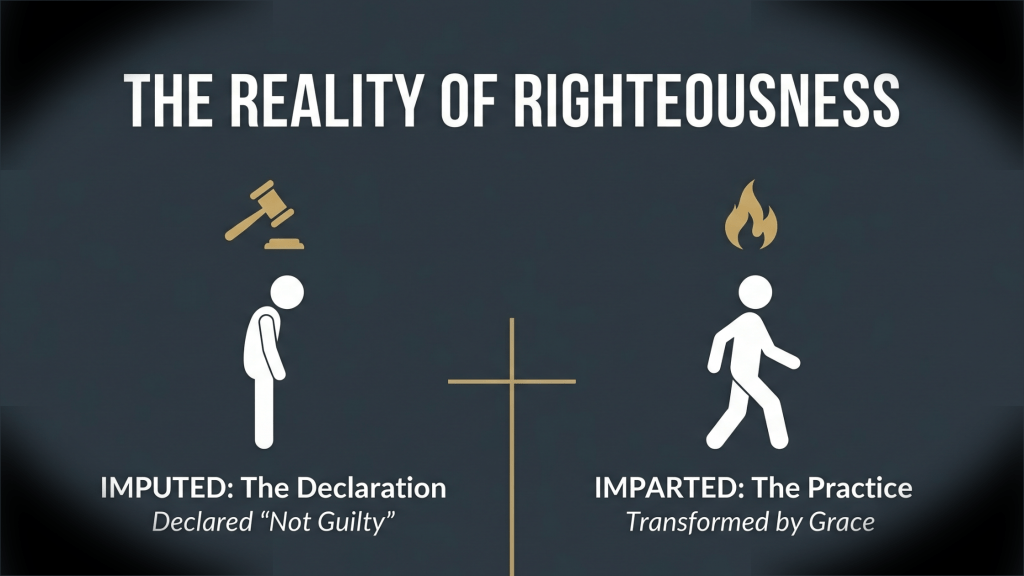
In The Declaration (Imputed Righteousness, which we will explore further later in this post), we see that when we respond to God’s grace with faith, Christ’s perfect record is credited (imputed) to our account. The Judge strikes the gavel and declares us “Not Guilty.” This is a purely forensic (legal) reality. We do not earn it; it is a gift (Ephesians 2:8-9).
Next, we look to The Practice (Imparted Righteousness, which we will go into more later in this post). God does not just declare us righteous and leave us in our sin. Through the indwelling of the Holy Spirit, He actually begins to make us righteous. Grace is not just a pardon; it is power. We are called to cooperate with the Holy Spirit to grow in actual, lived-out holiness (1 Thessalonians 4:3).
Then we have The Pursuit. The Kingdom takes priority as we see in Matthew 6:33, which commands us to seek His kingdom and His righteousness first. Matthew 5:6 promises that those who hunger and thirst for righteousness will be satisfied. 2 Timothy 2:22 commands us to “flee youthful passions and pursue righteousness.”
Righteousness brings friction with a fallen world. 1 Peter 3:14 notes that even if you suffer for righteousness’ sake, you will be blessed. 1 Peter 2:24 connects Christ’s suffering directly to our transformation: He bore our sins so that we might “die to sin and live to righteousness.”
So we can see that Biblical righteousness is both the objective, legal standing of innocence freely credited to us through faith in Christ, and the active, transforming life of holy obedience produced in us by the Holy Spirit. It means being made right with God positionally while actively reflecting His moral character practically. So how can we be sure and understand Imputed Righteousness?
Imputed Righteousness
For those unfamiliar with the term, “imputed” within a Christian context is best defined as “the crediting of one person’s actions or righteousness to another.” For example, the concept involves an individual’s sins being legally credited to Christ, and Christ’s perfect righteousness being credited to the believer.
Imputed righteousness has a multi-part explanation. The “Great Exchange,” explained in 2 Corinthians 5:21, is the cornerstone: Christ, who knew no sin, became sin for us so we might become the dikaiosynē (righteousness) of God. This is an alien righteousness—it comes entirely from outside of us.
We also see the fulfillment of the law in Romans 10:4, which declares that Christ is the culmination of the law so that there may be righteousness for everyone who believes. Philippians 3:9 reinforces this: our standing is not a righteousness of our own derived from the law, but that which comes through faith in Christ.
The result of this declaration is clearly shown in Romans 5:1-5; it highlights the immediate effect: because we have been justified by faith, we have peace with God. The legal war is over.
We see this concept not just in the verses above, but repeatedly throughout the New Testament. 1 Corinthians 1:18–31 describes the foolishness of the Gospel in the world’s eyes. Both Jews and Greeks rejected the idea of Christ crucified. Any god who would die on a Roman cross, especially as a sacrifice for human sinfulness, would be seen by worldly eyes as a weak and foolish deity. God, however, shames the wise and strong by giving the ability to believe in the cross of Christ mostly to the weak and foolish of the world, in human terms. In the end, nobody will boast before Him of their own strength and wisdom.
Romans 4:1–12 focuses on the faith of Abraham, referenced by Paul to further his case about faith. God only declares people righteous based on their faith in Him. David, as well, describes the one against whom God will not count their sin as ”blessed.” Paul insists that this blessing of being declared righteous by God is available to both the circumcised and the uncircumcised. After all, God declared Abraham righteous long before he was circumcised. In that way, he became the spiritual father of both believing Gentiles and believing Jews.
We even see this theme running through early church writings. Clement (96 AD), writing to the church in Corinth, stated that believers are not justified by their own works, wisdom, or piety, but “through faith, by which the Almighty God has justified all who have existed from the beginning.” He noted that even the patriarchs were justified by God’s grace rather than personal merit.
Another example is The Epistle to Diognetus (2nd Century). This anonymous early Christian letter outlines the idea of the “Great Exchange,” a foundational aspect of imputed righteousness. It famously states: “O the unexpected blessings, that the sinfulness of many should be hidden in one righteous man, while the righteousness of one should justify many sinners!”
Look also at Ambrosiaster (4th Century). Writing extensive commentaries on Paul’s epistles, Ambrosiaster explicitly connected faith to the gift of righteousness. Commenting on Romans 4:5, he wrote that “to an impious person believing in Christ, his faith is imputed for righteousness… an impious person is justified with God through faith alone.”
Over time, we can clearly see that this is not a man-made concept, but a truth rooted in Scripture and held by the early church, guided by the Holy Spirit and wisdom. As Christians, we stand confident in the fact that those who have an active faith in Christ Jesus stand legally righteous before God.
This raises the question: do we continue life as if nothing changed? Do we go out and do what we want to do regardless, letting grace abound more? What happens next?
Imparted Righteousness
What does “imparted” righteousness mean? In English, it simply means to bestow, lend, or provide a specific attribute or character to something. In Classic Christianity, it is the doctrine that the Holy Spirit actively instills and cultivates actual holiness and spiritual growth within believers, rather than just crediting them with external perfection. Scripture fiercely rejects the idea that a person can be legally righteous while living wickedly. But is this biblical, or a later addition to doctrine?
To understand Imparted Righteousness, we first have to remember the foundation of our salvation. In Romans 3:21–31, Paul introduces the ”good news” of the Gospel: entirely apart from the law, we are redeemed and declared legally righteous by the atoning sacrifice of Christ’s blood. This is Imputed Righteousness. We see this foundation again in Ephesians 2:1–9, which clearly states that salvation is a gift of mercy and grace, not human effort.
But having established that we are saved by grace and not by works, Paul immediately pivots in Ephesians 2:10: “For we are his workmanship, created in Christ Jesus for good works, which God prepared beforehand, that we should walk in them.” Grace saves us (Imputed), but grace also empowers us to live differently (Imparted).
So, if living righteously is not what saves us, do we just go on living in sin? The Apostle John strongly condemns this in 1 John 3:4–10, leaving no excuse for habitual sin. While this warning is often interpreted as a ”litmus test” for salvation, John’s specific audience is actually Christian believers. Salvation is no excuse for sin, because sin always disrupts our ”walk” with God. Those who only walk in sin and darkness cannot claim to be children of the light.
This habitual reality can be seen in 1 John 3:7, where John writes, “Whoever practices righteousness is righteous, as He is righteous.” The Greek verb for “practices” (poiōn) is a present active participle, indicating continuous, habitual action. True faith inevitably produces a life that aligns with God’s character. 1 John 5:18 confirms that one born of God does not make a habit of sin.
This echoes the Hebrew concept of tzedek. Proverbs 21:3 states that doing righteousness and justice is more acceptable to the Lord than sacrifice. Ezekiel 18:5-9 and Psalm 106:3 describe the righteous person not just by what they believe, but by what they do, walking in God’s statutes and doing what is just at all times.
James 2:14–26 makes the case that how one acts—their ”works”—are a sign of the kind of ”faith” they possess. So-called-”faith” which doesn’t lead a person to participate in good works is not a saving faith; it is a dead thing. It is pointless and meaningless to believe, or ”wish,” a poverty-stricken person to be well, if such an opinion leads to no action. In exactly the same way, James insists that it is not enough to mentally agree about certain facts of God. If what a person believes about God does not lead them to act accordingly, then their ”faith” is not saving faith. It is merely opinion. James never says that faith is not essential for salvation. He never claims works are required to obtain or keep salvation. He is, however, crystal clear that truly saving faith cannot be separated from the evidence of good works.
in Titus 3:14, after telling Titus that the church should assist Zenas and Apollos on their mission trip, Paul adds a plea. Christians should be diligent in pursuing good works, something mentioned frequently in this letter (Titus 1:16; Titus 2:7; Titus 2:14; Titus 3:5; Titus 3:8). This is specifically meant to apply to Zenas and Apollos, and the care given them by the churches of Crete.
Beyond that, believers of Crete are instructed to be efficient in their support, prioritizing issues of urgent need. This refers to meeting dire needs, or time-sensitive concerns. The Good Samaritan represents an example of this type of scenario. There, Jesus taught that a “neighbor” is a person in need (Luke 10:25–37). Believers are commanded to love neighbors as we love ourselves (Matthew 22:40), which includes meeting the practical needs of those around us.
Second Peter 1:8 also mentions this idea: acting out Christian principles is a way of avoiding “unfruitful,” or “wasted” living.
We see in Matthew 5:13–20 describe the essential role Jesus’ disciples and followers serve on the earth. They are the salt of the earth and the light of the world. These metaphors represent the impact Christians are meant to have in the world. That’s why it matters so much that they do the good works God gives them to do. Otherwise, they will stop being useful as salt and light. Instead, they should do those works, allowing their light to shine in the dark world in order that all who see will give glory to God.
Early church writings show this concept over and over again. For example, Irenaeus of Lyons (135–202 AD) In his foundational work Against Heresies, he wrote that Christ became what we are in order to enable us to become what He is. He viewed salvation as “recapitulation,” where humanity is gradually restored and transformed by the Holy Spirit into the divine likeness.
Clement of Alexandria (c. 150–215 AD) described the Logos (Christ) as the divine Educator who guides believers in the continuous process of being conformed to the image of God, emphasizing moral and spiritual transformation.
Augustine of Hippo (354–430 AD) who was arguably the most significant early Western voice on this topic, wrote in works like On the Spirit and the Letter, he argued that God does not just declare the ungodly righteous, but makes them righteous by pouring divine love into their hearts, transforming their very nature.
Here we see not just transformation but confirmation of regeneration by the finished work of Christ through the grace and guidance of the Holy Spirit. To this day, we continue to hold to these principles found in scripture as an understanding of true living faith of a Christian life.
The hardest truth of Imparted Righteousness is the paradox it places on the believer: it demands agonizing effort on our part, yet we can take zero credit for it. Philippians 2:12-13 captures this perfectly: we must “work out our own salvation with fear and trembling,” knowing all the while that “it is God who works in you.” The human flesh either wants to be entirely lazy (cheap grace) or take all the glory for being good (legalism). True Imparted Righteousness crucifies both.
So how do we live righteously? Is it through tradition? What traditions? Are we to try to be transformed? What does submission look like?
Tradition vs. Transformation
I hope in this section I can express a biblically based understanding of the schismatic differences between many of our Christian brothers and sisters. My goal is not to condemn those who adhere to traditions but to see and read as the earliest church understood tradition and transformation. The reason this is labeled “vs.” is to express biblical doctrine on the differences between these concepts and what does it mean for us Christians.
We read about imparted righteousness. Now we look to see furthermore what exactly transformation looks like. Romans 12:1–2 answers the question, ”How should we respond to God’s great mercy to us?” The answer is to become living, breathing sacrifices, using our lives up in service to God as an ongoing act of worship. That’s what makes sense. This is not a means to earn salvation, but the natural response we should have to being saved. To do this, we will need to break free from the me-first pattern of the world and have our minds changed in order to be able understand what God wants. Then we will know how to live.
In 2 Corinthians 5:17, Paul has written that Christ’s death for sin has changed the way he regards people. Instead of looking at each person as a mere human being, he must view those who are in Christ as something entirely different. Those who are “in Christ” are those who have faith in Him, credited with Christ’s righteous life, and their sin forgiven by Christ’s death in their place. Such people are new creatures. Those “in Christ” have become something they were not before. Their identity has changed from being the fallen version of themselves, to being associated with the righteousness of Christ. That’s who they are now.
In fact, the old version of a Christian, who they were before they were “in Christ,” is not recoverable. The old is gone, Paul writes. The new has come. All the old dreams and ideas and agendas and purposes have ceased to exist and have been replaced by Christ’s ideas and agendas and purposes in an entirely new creature called “Christian.”
Paul’s words are true in another way. The old way of humanity is also gone. The old way of the law is also gone. Christ is the long-promised new Covenant that makes it possible for men and women to be made new once and for all, and for eternity, with no possibility of returning to the old.
We see this again in Galatians 2:20. This is also Paul’s grandest declaration yet about what exactly happens when someone is saved or justified by placing their faith in Christ. In a very real sense, Paul’s argument is that we become so closely attached to Him that we die with Him and He begins to live in us. Paul has been emphasizing that faith, and faith alone, is what saves us—adding any requirement of good deeds or rituals is contrary to the gospel (Galatians 1:8–9; 2:16).
Christ was crucified for our sin. By faith, we trust that His death paid for our own personal sin. In that way, we are crucified with Him, our sin with Him on the cross. That sinful “us” dies, replaced by the resurrected Christ “in us.” We continue to live in the flesh, of course, but our lives are now directed not by our sinful selves but by our faith in Christ. Paul expands on this great truth powerfully in Romans 6:1–6.
For the first time, Paul mentions Jesus’ motive for giving Himself for us: love. Christ died for us because He loves us. Unlike the unyielding system of the law, Christ is a person motivated by His love and concern for us.
We read in 2 Thessalonians 2:15 regarding tradition, where Paul connects God’s call to salvation and the believers’ future glory to the obligation his readers have to stick with the truth. Many false teachers were trying to pull the believers away from the truth, and persecution and trials were buffeting them; so Paul urges his readers to hold their ground against the false teachers’ influence. He also urges his readers to keep a firm grip on the teachings they had received from him, whether he had given them when he was in Thessalonica or communicated them by letter. The New Testament often warns against drifting from the truth towards some different, false belief (Galatians 1:8–9; 1 Corinthians 4:6).
It is possible to slip back from a position of love for God and His Word. The risen Savior rebuked the church at Ephesus for having abandoned the love it had at first (Revelation 2:4). He admonished the church to “remember therefore from where you have fallen; repent, and do the works you did at first” (Revelation 2:5). We must constantly love the God of the Word and the Word of God.
In 1 Corinthians 11:1-2, Paul has spent much of this letter to the church in Corinth correcting some practices and warning against others. He pauses now, though, to commend or praise his readers. For all their flaws, this group apparently took Paul’s teachings quite seriously.
That is especially true of how they “maintain the traditions” Paul taught them. Comments such as this remind us that the Corinthian believers were sincere and dedicated, but fallible, just as we are today. The specific traditions Paul had in mind likely had to do with how Christians should conduct themselves in their meetings. That is the next topic he covers. Though he has praised them, he will also correct them on key areas where they are not uniformly continuing to follow his teaching.
The Greek term used here is paradoseis, which carries a strong sense of something which is “handed down,” or “passed along.” As used in the Bible, it often comes with context about whose teaching or tradition is being mentioned (Matthew 15:2; Mark 7:3; Galatians 1:14; 2 Thessalonians 2:15). The English word traditions can be misunderstood as something always invalid or unreliable. The word, as used, simply means a teaching, which can be either good or bad, depending on its own merits. Paul’s praise here is not that the Corinthians are following “tradition” in a general sense; rather, it’s that they are faithful to his specific teachings.
Paul is not speaking about cornerstone truths in this case. What he’s referring to are the specific teachings he has given to the believers in Corinth. These are the instructions passed down from Paul—the “traditions”—of how they are to apply their knowledge of the Word and the gospel.
Going back to 1 John 3:17, John again refers to his readers as “little children,” a term he uses seven times in this letter in reference to believers. Jesus also referred to His followers as little children (John 13:33). They are warned not to be deceived. False teachers were spreading dangerous and phony spiritual claims. This is why John speaks in such strong terms throughout this letter.
A believer who is truly walking with Christ will practice what is right, just like Jesus did. Ultimately, we cannot know for certain the spiritual condition of others (1 Samuel 16:7). We can judge behaviors. However, as far as this principle is concerned, there is no need to judge another’s salvation. In fact, we should be careful about making such judgments in the first place. Regardless of what their spiritual state is, if a person lives contrary to the teachings of Jesus, they are not “in fellowship” with God and are not to be listened to or followed. False teachers have existed throughout the church’s history, even as early as when John wrote his letters.
If the complex liturgical systems of Rome or the East did not exist in the first century, what specific, daily ‘practices’ do you think the Apostle John was actually commanding his readers to do in 1 John 3:7? And what does John actually mean by “practicing righteousness”? We do not have to guess or insert later traditions, because John defines it explicitly in the very same chapter. In 1 John 3:23, he writes: “And this is his commandment, that we believe in the name of his Son Jesus Christ and love one another, just as he has commanded us.” To practice righteousness in John’s context meant two things: moral purity (walking in the light, not the darkness) and active, sacrificial love for the brethren (1 John 3:16-18).
Then we have a warning in Colossians 2:8. In prior verses, Paul focused on a positive depiction of the Colossian believers and their faithfulness. As mentioned, he transitions to warning them against false teaching.
Jesus came to set captives free (Luke 4:18; Romans 7:6; Galatians 3:23), not to leave people in spiritual chains. Paul personally dealt with sin seeking to make him captive (Romans 7:23), yet fought against every evil thought to make it captive to Christ (2 Corinthians 10:5).
What could take the Colossians captive? Paul mentions “philosophy,” which he means in a very specific sense. This is not a broad reference to all meanings of that term. The Bible’s stance on deep thinking, logic, and philosophy-as-philosophy is very positive (Acts 17:11; 1 John 4:1; Proverbs 15:28). In this context, Paul is condemning philosophy which is based on explicitly anti-Christian principles. In verse 4, he referred to these kinds of arguments as “deceptive,” using a Greek term which implies trickery or cheating. In other words, actual critical thinking is not the problem. Self-deluding, worldly philosophical “tricks” are the problem (2 Timothy 3:7). The false teachers of Colossae are using these kinds of attacks against Christ.
Paul refers to “empty deceit.” This would include hollow rhetoric or outright lies. “Elemental spirits,” in this context, is a reference to the basic assumptions we use in our thinking (Galatians 4:3). If a person starts from a blatantly anti-spiritual standpoint, they are going to come to anti-spiritual conclusions. This, again, reminds us that fallen human wisdom can be at odds with Christ’s teachings.
Paul also refers to “human tradition,” reminding the reader that simply because an idea is preferred, or historical, does not make it true. The phrase in Greek is paradosin tōn anthrōpōn. This implies the laws, rules, or handed-down regulations of humanity. Paul wants the Colossians—and all believers—to focus on truth, and on Christ, not on trickery and human preference.
What did the early church say about these things? The Didache (100 AD) -Also known as The Teaching of the Twelve Apostles– this early church manual preserves practical traditions regarding baptism, fasting (e.g., Wednesdays and Fridays), and the Eucharist.
Ignatius of Antioch (110 AD) Writing on his way to martyrdom in Rome, Ignatius stressed the importance of holding to the traditions of church leadership (bishops, presbyters) and the true humanity/divinity of Christ to guard against heresies.
Irenaeus of Lyons (180 AD) In his work Against Heresies (180 AD), he argued that the Church’s faith is preserved by the “rule of truth” handed down directly from the Apostles to the bishops of major churches. He maintained that even without scripture, the Church would rely on this living, oral tradition.
Tertullian (200 AD) In The Prescription Against Heretics , he challenged heretics by asking which churches could trace their teachings and leadership directly back to an Apostle. He viewed this unbroken lineage of doctrine as the ultimate proof of orthodoxy.
In the 2nd century, Gnostic heretics were claiming they possessed “secret, hidden knowledge” passed down privately from the Apostles. Irenaeus and Tertullian appealed to the visible, unbroken lineage of bishops to prove a simple point: The Apostles had no secret teachings. The “tradition” (the Regula Fidei, or Rule of Faith) they defended was identical to the public teachings recorded in the New Testament. Tradition was not a second stream of new revelation; it was the exact same gospel echoing through the early church.
The earliest church writings—forged during persecution from the Roman Empire and displaying faith, tact, and an understanding of Apostolic authority—paint a clear picture for us to follow. We hold Scripture as the authority (Old Testament and New Testament) and with the New Testament being the life, testimony, and guidance of Christ and the Apostles who were ordained by Christ to spread the gospel. (Check out our blog on “Is the Bible Trustworthy?“)
To the original first-century audience, “practicing righteousness” did not mean performing liturgical rituals, observing church calendars, or following ecclesiastical traditions. It meant living a life of active moral obedience to Christ—specifically characterized by forsaking habitual sin and selflessly loving other believers—in direct defiance of the false teachers of their day who claimed physical behavior did not matter.
So what is this moral obedience to Christ? What is God’s moral character? What does this mean to us? How does it affect us?
What is God’s Moral Character?
To understand God’s character, we must look at how He reveals Himself in Scripture, moving from the Old Testament foundation to the New Testament fulfillment. I will break this down into four parts, The Foundation of Holiness (Qadosh), The Foundation of Love (Chesed / Agape), The Moral Law as Autobiography, and The Christological Fulfillment.
Let us begin with The Foundation of Holiness (Qadosh). In Leviticus 19:2, God commands, “You shall be holy, for I the Lord your God am holy.” (We will go further into this in the next section of this blog). The Hebrew root qadash means to be cut off, separated, or distinct. Morally, it means God is completely separated from all sin, evil, and corruption. To live by this character means we are “set apart” from the polluted systems of the world (1 Peter 1:15-16).
Clement of Rome (c. 95 AD) In his Epistle to the Corinthians, he frequently hallows God as the Creator who dwells among the pure. Clement defined holiness as complete submission to the divine will and warned that believers must approach God with “holiness of heart”.
Hebrews 12:14 makes an important statement saying “…and for the holiness without which no one will see the Lord”. This verse does not mean we’re meant to be saved .based on our “good behavior”; rather, it explains that it is impossible for an imperfect, unholy sinner to stand before God (Isaiah 6:5) — we must be perfectly righteous to be in His presence (Exodus 33:19–20). That exact point will be made later in this chapter when the writer refers to God’s display at Mount Sinai (Hebrews 12:18–29).
That ability to stand in the presence of God, however, is exactly what we gain from Christ’s finished work on our behalf (Hebrews 9:11–12; 1 John 3:2). The holiness we need to “see the Lord” comes from Christ, by His grace, and through our faith in Him (2 Corinthians 5:21; 1 Peter 3:18). Striving to live according to that standard should be the natural desire of every saved believer (John 14:15).
Next, The Foundation of Love (Chesed / Agape). When God reveals His glory to Moses in Exodus 34:6-7, He describes Himself as “merciful and gracious, slow to anger, and abounding in steadfast love (chesed) and faithfulness.” In the New Testament, 1 John 4:8 tells us “God is love” (agape—a volitional, self-sacrificial love). His justice and His love never compete; they are in perfect harmony.
In the second sentence of 1 John 4:8, John adds the comment that those who don’t love have no fellowship with God. The phrase “know God” uses the Greek root word ginosko. This is the same term used in verse 7, and many other places in the New Testament (John 17:3). To “know” God requires a person to have a relationship with Him, something John stresses often in this letter to Christian believers.
Love comes from God, so those who demonstrate love show they have fellowship with Him. The inverse is also true. The person who does not demonstrate love does not know God. John has already highlighted this message in previous chapters. However, the emphasis in this section is that God is love. Love is essential to Christian living because it is an essential part of God’s identity.
This love includes God’s creation of all things (Genesis 1—2), sustaining all things (Colossians 1:16–17), and redeeming believers through His Son Jesus (1 John 4:9). God is love, and He serves as the creator and sustainer of love in our world. Empowered by Jesus, we can experience God’s love and share it with others through our lives.
St. Ignatius of Antioch (110 AD) In his epistles written while being transported to Rome for martyrdom, Ignatius frames the love of God as the ultimate path to true life. He famously wrote that his desire was to be “ground by the teeth of wild beasts” so he could become the “pure bread” of Christ, stating: “The beginning is faith, the end is love. The two bound together in unity are God.”
St. Augustine of Hippo (c. 4th–5th Century) St. Augustine profoundly explored 1 John 4:16, dedicating many sermons to the reality that God is Love. He saw love as the binding force of the Trinity and the primary motivation for all Christian action. In his Handbook on Faith, Hope, and Love, he detailed how right worship of God is rooted entirely in these three virtues, with love reigning as the greatest.
Then, The Moral Law as Autobiography. The Ten Commandments (Exodus 20) are not arbitrary rules God invented to test us; they are a written reflection of His unchanging nature.
- We do not murder because God is the Author of Life.
- We do not commit adultery because God is Faithful to His covenants.
- We do not lie because God is Truth.
Old Testament laws are traditionally categorized into three types: moral, ceremonial, and civil. The moral laws outline what God deems universally right and wrong, reflecting His holy character. Unlike ceremonial or civil codes, they transcend ancient Israel’s culture and apply to all people.
We see in Matthew 5:20, Jesus says, “For I tell you, unless your righteousness surpasses that of the scribes and Pharisees, you will never get into the kingdom of heaven.” At first this sounds terrifying and impossible. This is to show that it was not on our works, that is Christ alone that saves us. The law is merely there to remind us how much we need a savior and to understand the fullness of this gift of grace through Christ.
Facing critiques over Old Testament violence, early church writers reconciled these accounts by attributing Yahweh’s actions directly to Christ. Writers like Justin Martyr identified Jesus with the pre-incarnate Wisdom of God, viewing Him as the righteous agent of both grace and judgment.
Church Fathers like Augustine of Hippo framed morality as a response to divine grace. They taught that true moral integrity is achieved when human actions are rooted in God’s will and divine love.
Finally, The Christological Fulfillment. (Check out our podcast episode on “Does Christ Claim to be God?“) The ultimate revelation of God’s moral character is Jesus Christ (Hebrews 1:3). In the Sermon on the Mount (Matthew 5-7), Jesus takes the external moral law and applies it directly to the human heart. He reveals that God’s character requires not just the absence of murder, but the absence of contempt; not just the absence of adultery, but the absence of lust.
A major theme of the book of Hebrews is the supremacy of Christ. Faced with persecution, there is a temptation to follow the crowd. Jewish Christians of that era would have been under pressure to return to Judaism, rather than continue as Christians. The first four verses of Hebrews serve as an introduction to the idea that Jesus is the better way.
Hebrews 1:3 also provides important support for the divinity of Jesus. That is, these words imply that Jesus Christ is, in fact, God. The Greek word characktēr is translated here as “exact imprint” or “exact representation.”. The Greek word for “nature” here is hypostaseōs. This is the source of the theological term “hypostatic union,” a fancy way of saying that Jesus is both God and man. Combined, these words mean that Jesus’ nature is identical to that of God. Christ is divine, exactly as God is divine.
The reference to sitting at the “right hand” is important in ancient literature. This is a symbolic reference to honor and power. A person seated at the right hand of the king was considered trustworthy, and he was bestowed with the power of that king. References to Jesus as “seated” at the right hand of the Father imply His absolute power and authority.
The Didache (c. 1st–2nd Century) Also known as The Teaching of the Twelve Apostles, this early document outlines a stark division between the “Way of Life” and the “Way of Death”. It strictly forbids abortion, infanticide, murder, and sorcery, emphasizing community sharing and almsgiving (Check out our extensive blog post on The Didache).
Going back to The Epistle to Diognetus (2nd Century), it outlines the “stranger” status of Christians in the Roman Empire. It states that believers dwell in their own countries but act as sojourners, noting: “They marry, as do all; they beget children; but they do not destroy their offspring.” It highlights that Christians share a common table, but not a common bed.
Early Christians were aggressively pro-life in a Roman culture that frequently practiced abortion, exposure of unwanted infants (infanticide), and gladiatorial combat. Early church writers frequently opposed military involvement. Early apologists like Justin Martyr (c. 110–165 AD) referenced prophecy to argue that the kingdom of God was inherently peaceful, and Christians refused to shed blood. The church demanded strict sexual morality, condemning adultery, fornication, and homosexuality—sins that were broadly tolerated or normalized in the pagan Greco-Roman world.
When we look at the early church martyrs, did they die for a set of liturgical rituals, or did they die because they refused to compromise the exclusive, moral truth of Jesus Christ?
We see consistency with what was held regarding God’s morality based on scripture, proper exegesis, and common grounds amongst followers of Christ. We are to go to the sources (the apostles, the old testament, the words of Christ) to align ourselves with Christ with the strength and conviction of the Holy Spirit. We are called to be Holy (1 Thessalonians 4:7, 1 Peter 1:15-16, 2 Timothy 1:9). So what does it mean to be Holy?
Holy for He is Holy
When reading 1 Peter 1:15-16 (within the broader context of verses 13-25), it can be tempting to walk away in discouragement. A shallow reading may lead us to believe that God requires absolute perfection from His children right now and forever. And yet, we can’t seem to find any of God’s children who are leading perfect lives. So what do these verses mean?
It is helpful to see them as being about our identity in Christ, as well as about our conduct. In his letter thus far, Peter has already described believers in Jesus as people who are saved, are being saved, and who will be saved. He has told us to change the direction of our minds and actions while already giving us the title of “children of obedience.” Now in verse 15, he reinforces what we know. We know our God is “holy,” set apart, “other” from the rest of fallen creation. What we may not realize is that we, too, are made to be holy, set apart, “other” from the rest of humankind. The emphasis seems to be that we must live up to what we already are.
We will not achieve perfectly sinless conduct on this side of eternity. However, we are made to be completely set apart from the world in our conduct right now. In Christ, we are holy. In Christ, we must live as holy people live. Our right choices will not save us. Peter’s letter has made clear that salvation has already taken place and only by God’s grace through faith in Christ. We are saved people. We are God’s people. Now we must live like God’s people. That is God’s standard for us, and it should be our standard for ourselves—even with the understanding that we will fail along the way.
In 2 Corinthians 7:1, Paul begins by referencing “these promises” possessed by those who are in Christ. He has just referenced several Old Testament Scriptures connecting God’s promises to the Israelites with their obedience at separating from ungodly nations and unclean things. Some of God’s promises to Israel depended on the Israelites’ willingness and ability to obey God in this way. This was the structure of the old covenant.
Under the new covenant, however, are God’s promises to live with those who are in Christ, to be their Father, and to welcome them into His presence forever. These are not dependent on the believer’s ability to obey; they are dependent only on Christ. Paul wrote at the beginning of this letter, “For all the promises of God find their Yes in him. That is why it is through him that we utter our Amen to God for his glory” (2 Corinthians 1:20).
In other words, to have God’s promises in Christ is to have them securely. How should believers respond to rock-solid promises from the God who does not lie? We must clean ourselves up in both body and spirit. Since God lives in believers right now in the Holy Spirit, Christians must remove from their lives anything that is in any way opposed to God. For the Corinthians, who lived in a culture that had normalized idol worship, this included removing any and every connection to the worship of idols or false gods.
This ongoing process of cleansing our lives from things that are opposed to God is how a believer participates with God in “bringing holiness to completion.” God is the one who sets a believer aside as His, as holy, as set apart for His purposes. He does that for all who come to Him through faith in Christ and He begins the process of making that person new in the image of Christ (2 Corinthians 5:17).
Paul wrote that God will also finish this work in every believer (1 Corinthians 1:8). Christians, though, must participate by obeying God’s commands to set aside every disobedience “in the fear of the Lord.” That fear is about great respect for God’s power and righteousness. It’s also about carrying an awareness that Christ will judge the works of every believer when He returns, not to decide that person’s eternal destiny but to give to him or her what is due for how they lived as believers (2 Corinthians 5:10).
We see in 1 Peter 2:9 Peter uses language that had been used to describe God’s special relationship with Israel. As Israel was, we—believers, the church—are also a chosen race. Unlike Israel, though, we are not a race in the sense of our family, ethnicity, skin color, or country of origin. We are a spiritual race, in the sense that, in Christ, we share a single spiritual Father. In that same meaning, we are a “holy nation,” a specific group of people called out and set apart from all other nations.
Christians, together, are a royal priesthood. In Israel, under the Law, one tribe was given the task of serving as priests, performing the duties of mediators between God and the rest of the nation. Very few held the honor and responsibility of actually coming into God’s presence. But in and through Christ, the King, all believers are priests with direct access to our Father. We need no other mediator.
Finally, God has formed this nation, this race, this priesthood to take possession of us. We are His people in a very real way. It’s not just that we pledge our allegiance to Him; it’s that He has taken ownership of us. We belong to Him.
Why? For one, He has made us to declare His praises. That’s more than just a natural response to our Father’s mercy or something we should do to be polite. Declaring God’s greatness is one reason for our very existence. When we praise Him, we fulfill our purpose. He has called us out of the darkness of a meaningless life, and an eternity apart from Him, and into His wonderful, marvelous light. Because we belong to Him, we belong in His light.
In 1 Clement (95 AD) written by Clement of Rome to address division, this letter urges believers to “draw near to God with holiness of spirit”. It emphasizes that Christians, as the portion of the Holy One, must avoid impurity, pride, and malice, while actively pursuing humility.
Irenaeus of Lyons (130–202 AD) In his treatise Against Heresies, he taught that holiness requires actively being “full” of the Holy Spirit rather than being “empty.” He viewed holiness as the result of a sober-minded life guided by heavenly law and the pursuit of truth.
Clement of Alexandria (150–215 AD) wrote extensively about holiness as a transformative process where the believer actively participates in grace to grow into the moral likeness of God.
We can see early writers, later echoed by theologians like John Wesley, viewed holiness and love as mutually exclusive to sin. A heart filled with love for God and neighbor cannot simultaneously harbor hatred or malice.
When we submit ourselves to God, we are indwelt by the Holy Spirit that helps strengthen us, guide us, and express God’s character through us (Galatians 5). We can see a consistency of doctrine throughout Scripture and the early church regarding these truths.
Conclusion
Righteousness is not a mountain we climb in our own strength, nor is it a meaningless title that allows us to remain comfortably dead in our sin. As we have seen, biblical righteousness is a beautiful, paradoxical reality. It begins with the Great Exchange—Christ’s perfect record graciously credited to our account (Imputed Righteousness)—and it blossoms into a transformed life where the Holy Spirit actively cultivates actual, lived-out holiness within us (Imparted Righteousness).
We are not called to blindly follow the empty traditions of men or the “cheap grace” of modern emotionalism. Instead, we are called to be completely made new. We are called to be living sacrifices who actively reflect the unchanging moral character of a God who is both perfectly Holy and entirely Love. His standard is absolute perfection—a standard that shatters our pride, drives us to the cross in repentance, and empowers us to walk in the light as a royal priesthood.
The reality of righteousness is that it costs us our pride to receive it, and it costs us our lives to walk in it. But the reward is unbroken fellowship with the Creator of the universe.
Join the Conversation
If you haven’t already, I highly encourage you to listen to the companion podcast for this post: GTP Guest: Brandon – What is Biblical Righteousness?, where Brandon and I unpack these concepts even further.
Are you wrestling with the balance between grace and obedience? Do you have questions about how to practically pursue holiness in a fallen world, or how to talk to others about it? Come join our community! Head over to gospeltruthproject.com and click the link to join our Discord server. We have a dedicated team of believers ready to discuss apologetics, pray together, and grow in the Word. Let’s pursue the meat of the Gospel, side by side.
I challenge you reader, to then look at your life, day by day, hour by hour, and see how does your life look to the Christian walk we are called to in righteousness? With that, God bless you brother or sister in Christ.


